65% of online shoppers return fashion items because the size is wrong. 12 companies tracking fit solutions in 2024–2026.
US retail returns reached $849.9B in 2025. Online return rates run at 19.3% — structurally higher than in-store because customers cannot try before they buy. The single largest driver is fit. AI-powered sizing engines, 3D body scanning, and virtual try-on have moved from pilot to production — tracked across 12 companies, with verified metrics and pricing.
$849.9 billion in returns. Fit is the largest single cause.
Online return rates are structurally higher than in-store because customers cannot try before they buy. Fashion and footwear sit at the top of the return curve — and fit is consistently the leading reason given when customers send items back.
Approximately half of all items ordered on Europe's largest fashion platform are returned — driven by free-returns policy and multi-size ordering behaviour. Zalando Corporate
Source note: The $849.9B and 19.3% figures are from the NRF 2025 Retail Returns Landscape. The 65% fit-as-reason figure is from DealNews research cited by Shopify's February 2025 returns guide. This represents the percentage of returners who cited fit — not the share of all purchases returned. The ~50% Zalando return rate reflects Europe's higher fashion return culture driven by free-returns policies.
The core mechanics: online shoppers cannot test fit before purchase, so they order multiple sizes (bracketing) and return what does not work. Each returned unit generates a logistics cost that is rarely fully recovered. Sizing technology addresses the problem at the source — before the purchase is made.
02
Evaluation Framework
Ease of implementation vs. cost — where each solution sits
Each dot is one solution plotted on two axes — how hard it is to integrate (left = complex, right = easy) and what it costs (top = expensive, bottom = cheap). Google and Snap sit bottom-right: free, no integration needed beyond a standard product listing. WANNA and 3DLOOK sit top-left: custom SDK builds, high cost. Everything in between is API-based SaaS with subscription pricing.
12 Fashion Sizing Solutions — Implementation Complexity vs. Cost
Notes: 12 solutions plotted across three technology categories. Ease of implementation reflects technical integration complexity based on published documentation. Cost positioning reflects published pricing where available (see Section 08 Pricing); enterprise-custom platforms are positioned by inferred market tier. AI Sizing Engines (blue) tend to sit in the mid-range on both axes. Body Scanning tools (amber) skew toward complex integration due to photo-capture flows. Virtual Try-On platforms (fuchsia) range from free/platform to highly custom. Only Google Shopping VTO is confirmed free for retailers.
03
Category 1
AI Sizing & Fit Recommendation Engines
These platforms sit between the retailer's product catalogue and the customer's purchase decision, using machine learning to recommend the right size based on past purchases, body data, and garment-level fit profiles. They run as plugins or APIs — invisible to the shopper, directly integrated into the product page.
AI Sizing Engine
True Fit
SaaS — Apparel & Footwear
True Fit's platform connects shopper identity data with garment-level fit attributes across a dataset of 82 million shoppers and nearly 30,000 brands. The engine predicts size, fit preference, and likelihood of return at the individual shopper level. In November 2024, True Fit became the first — and only — size and fit app to achieve Shopify Plus Certified App Partner status. Adoption on Shopify increased 509% over the prior twelve months.
Bold Metrics creates a "digital twin" of each shopper's body from minimal inputs and combines it with garment-level fit data to generate personalised size recommendations. In March 2026, Gap Inc. announced it is testing Bold Metrics' new Agentic Sizing Protocol — enabling conversational AI shopping agents to ask natural-language questions and return size recommendations. The protocol is being piloted across Gap, Old Navy, Banana Republic and Athleta.
MySize operates the Naiz Fit AI sizing platform, delivering personalised size recommendations at scale. The company reported $8.5M in revenue for 2024 (23% year-on-year growth) and targets $15M for 2025. Across 18+ countries and over 42 million size recommendations, Naiz Fit's deployed metrics show a 5.7x improvement in conversion rates and a 14% reduction in return rates. Average order value rose 27% in tracked deployments. The Naiz Fit Shopify app was removed from the Shopify App Store in September 2024; integrations now run via direct B2B API.
Fit Analytics was founded in Berlin in 2010 and acquired by Snap in 2021. In March 2024 it was spun off and re-established as an independent company. The platform powers size recommendations for 250+ fashion retail partners globally, generating over 4 billion monthly recommendations. Its client base includes ASOS, Lacoste, Tommy Hilfiger, The North Face, Calvin Klein, and Puma. The platform integrates via API into any e-commerce platform and uses purchase and return data to continuously improve recommendation accuracy.
Virtusize takes a distinct technical approach: instead of asking customers for their body measurements, it compares the dimensions of the item they are considering against garments they already own and love. The customer selects a garment from their wardrobe, and Virtusize generates a fit recommendation based on how the two items compare. The platform is trained on 150 million orders. Clients include Under Armour, Uniqlo, New Balance, Kate Spade, Acne Studios, Balenciaga, AllSaints, Ralph Lauren, Levi's, and Canada Goose. A self-service entry tier (LITE, from $99/month) is listed as coming soon.
NRF Top 50 Retail Tech 2025 · Google for Startups AI Accelerator 2025
AI Sizing Engine
Measmerize
SaaS plug-in — Luxury & Premium Apparel
Measmerize focuses on the luxury and premium apparel segment, offering AI-powered size recommendations via a Shopify plugin and API integration. It was selected for the NRF Top 50 Retail Technology Companies in 2025 and the Google for Startups AI Accelerator in 2025. Clients include Prada, Miu Miu, Fendi, Loewe, Moncler, Golden Goose, Herno, Zegna, Lanvin, Dunhill, and Stone Island. The Shopify plan starts at $49/month with a 14-day free trial.
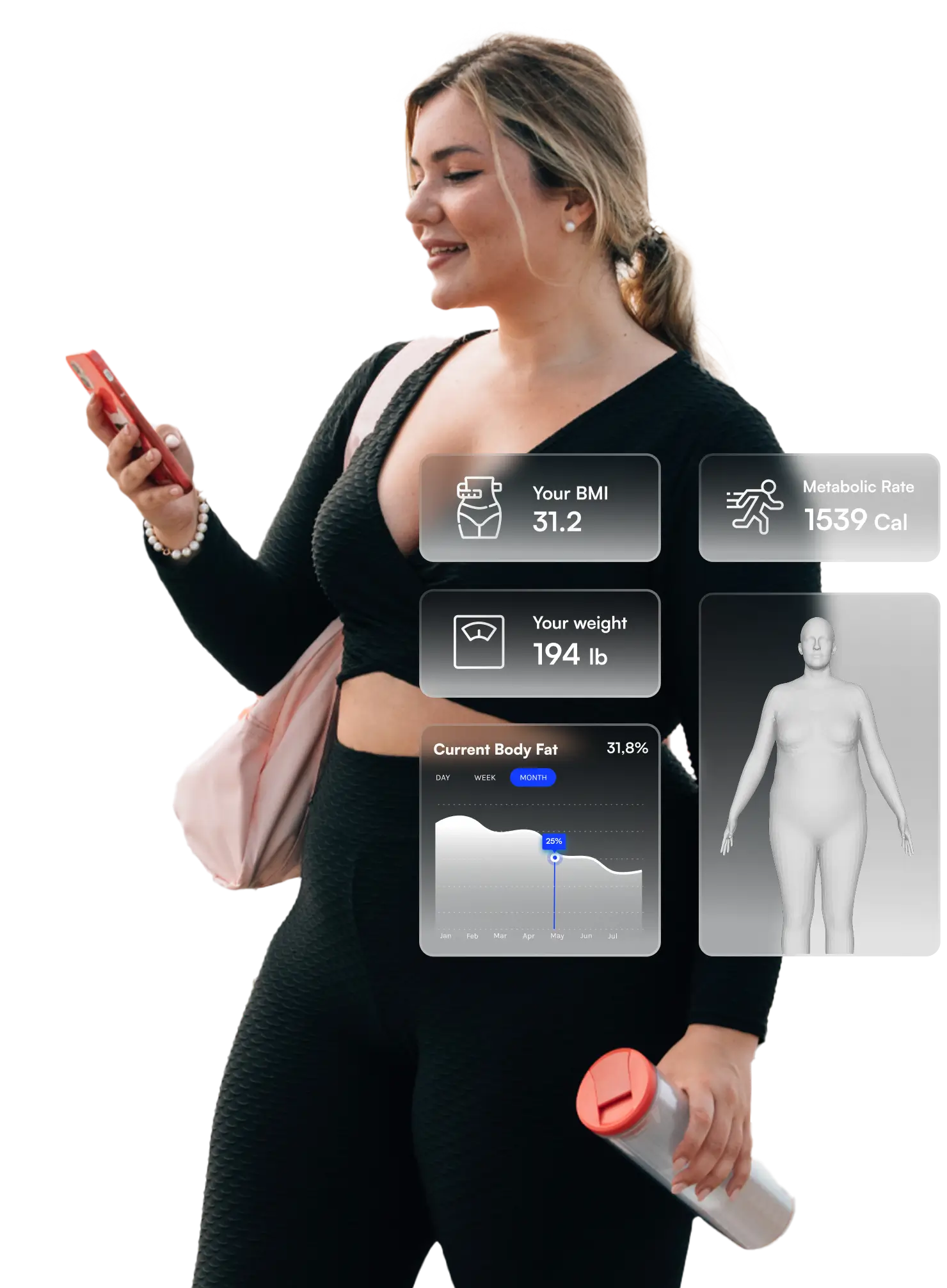
Body scanning technology removes the measurement step that made made-to-measure inaccessible at scale. Instead of a physical fitting, shoppers take two photos on a phone. The AI extracts 80+ body measurements in under a minute — enabling size recommendations, custom pattern generation, and virtual fit simulations.
Digiday Best In-Store Technology 2024
Body Scanning AI
3DLOOK
B2B Platform — Made-to-Measure & Uniform Fitting
3DLOOK has two distinct products. Mobile Tailor captures over 80 body measurements from two smartphone photos in 45 seconds — used for made-to-measure apparel, uniform fitting, and workwear (Safariland case study). The technology achieves 96–97% accuracy and 95%+ measurement repeatability. FitXpress, launched in 2025, is a virtual fitting room product that shows shoppers how a specific garment fits their body using the same measurement technology. The company won Digiday's Best In-Store Technology award in 2024.
MySizeID (part of the MySize group) offers a mobile app that measures the user's body using smartphone sensors and camera. Shoppers receive a personal size profile synced across supported retailers. The B2B API allows fashion retailers to embed size recommendations directly in their checkout flow, pulling from the user's existing MySizeID profile without requiring re-measurement. Available on iOS and Android. The Shopify app integration was removed from the Shopify App Store in March 2026; B2B integrations now run via direct API.
Virtual try-on lets shoppers see how a specific garment looks on their own body before purchase — either through augmented reality on a live camera feed, or by uploading a photo. Platform-level deployments from Google and Snap bring this capability to billions of product listings without requiring brands to build their own tool.
Launched May 2025 — Search Labs US
AI Image Generation Try-On
Google Shopping Virtual Try-On
Platform — Integrated in Google Search
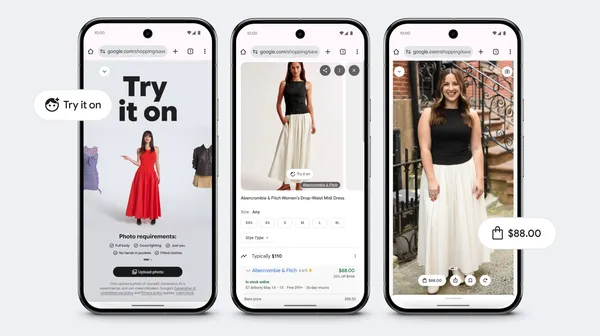
Google launched Virtual Try-On in Search Labs in the US on 20 May 2025. Shoppers upload a full-length photo and see how clothing items from Google's Shopping Graph look on their own body. The underlying model understands how different fabric materials fold, stretch, and drape on different body types. The feature works across shirts, pants, skirts, and dresses from Macy's, Kohl's, Walmart, Nordstrom and others. At launch, Google described it as "the first of its kind working at this scale, allowing shoppers to try on billions of items."
Snapchat's catalog-powered Shopping Lenses enable brands to create virtual try-on experiences for apparel, footwear, and accessories directly in the Snap camera. Shoppers can try on up to 20 products in a single session. A study by Alter Agents found 80% of shoppers felt more confident in their purchase after using AR try-on. Eyewa, using Shopping Lenses, achieved 8X return on ad spend. Snap has reported 250M+ Snapchatters engaged with AR shopping lenses, with 5B+ total engagements.
80%
more confident to buy
8×
ROAS (Eyewa)
250M+
users engaged
Source:Snap for Business; Alter Agents study. Note: the 250M user and 5B engagement figures were reported in early 2022; the 80% confidence and 8X ROAS are from the same period.
WANNA provides 3D and AR virtual try-on for footwear, bags, jewellery, watches, scarves, and clothing. Its client base is concentrated in luxury and premium fashion: Farfetch, Dolce & Gabbana, Valentino, Balenciaga, IWC, Diesel, and Tod's. Dolce & Gabbana achieved a 6x increase in conversion rate with WANNA's implementation. In June 2025, WANNA launched virtual try-on for high-heeled shoes — the first solution to handle the specific geometry of heel elevation, supporting 7cm–9cm heel heights.
Zero10 is an AR fashion platform that enables realistic real-time virtual try-on via phone camera. Shoppers can try on digital garments, record video, and share content. Zero10 operates a direct consumer app (iOS and Android) alongside brand partnerships. Retail and fashion partnerships include Coach, Ugg, and Macy's; entertainment partnerships include Disney. In-store AR mirror installations are deployed with independent designers. The app was updated in November 2024 (v2.6.1) and April 2025.
TryStyle is an AI-powered visual try-on platform that lets shoppers see how apparel looks on them before buying. The app uses AI image generation to place garments on a user's photo, enabling style exploration and fit confidence without a physical fitting. Available on Android via Google Play.
Walmart acquired Israeli fashion tech startup Zeekit in May 2021 and rebuilt its try-on capability as "Be Your Own Model" — allowing Walmart.com shoppers to upload a personal photo and see clothing on themselves. The feature uses machine learning to simulate shadows, fabric draping, and fit on individual body types across Walmart's private-label brands, select national brands, and marketplace sellers. Available on 270,000+ apparel items at launch and expanding.
In-House Technology — Fashion Retailers Building Their Own
The largest fashion retailers did not wait for third-party solutions to mature — they built proprietary sizing and virtual try-on tools and deployed them directly inside their own apps and e-commerce platforms. These in-house systems give retailers full control over the customer data generated, but require significant engineering investment to build and maintain.
Launched December 2024
3D Avatar Try-On
Zara
In-App — Zara iOS & Android
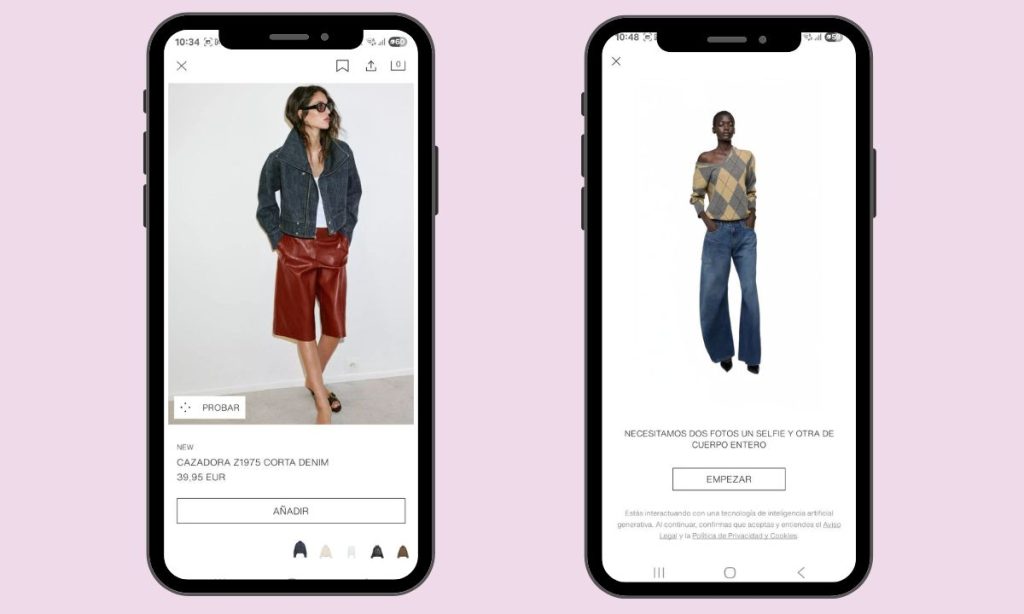
Zara's virtual try-on creates a personalised 3D avatar from a single selfie and a full-body photo taken within the Zara app. The avatar replicates the shopper's proportions and moves realistically — walking, turning — while wearing selected Zara garments. The tool launched in December 2024 across five markets: Mexico, the UK, Germany, the Netherlands, and Italy. Spain was added in a subsequent expansion. No third-party platform is involved; the technology is fully built and operated by Inditex.
Amazon launched its Virtual Try-On API via Amazon Bedrock (the Nova Canvas model) on July 2, 2025. Developers upload a person image and a garment image; the AI generates a photorealistic composite showing the garment on the person. The API supports apparel and accessories. Available in US, Tokyo, and Ireland regions at launch. Unlike Amazon's consumer-facing try-on feature, this API opens the underlying model to third-party retailers and developers building their own shopping experiences.
Zalando's size-recommendation feature uses a two-photo upload (front and side view) to generate body measurements and recommend the right size for specific garments. Launched in July 2023, the tool addresses a structural challenge for Zalando: size-related returns account for approximately one third of all returns. The deployed system reduced returns by 10% on items where the feature was used, according to Zalando's own figures. Available to all Zalando shoppers via the app.
Nike Fit uses augmented reality to scan both feet in under 15 seconds via the Nike app camera. The scan captures 13 data points per foot and generates a precise size recommendation across Nike's footwear range — accounting for differences between left and right feet, which most people have. The tool also addresses the specific fit characteristics of different Nike silhouettes. Available within the Nike app for iOS and Android since 2019.
ASOS Fit Assistant asks shoppers three questions — height, weight, and age — alongside purchase history analysis to generate size recommendations for specific garments. The tool cross-references the shopper's profile against return data from customers with similar body measurements who bought the same item, generating a size recommendation with confidence level. Available across ASOS.com and the ASOS app since 2018.
5 In-House Solutions — Consumer Effort vs. Technology Generation (2018–2025)
ASOS built a simple 3-question recommender in 2018. Nike added AR foot scanning in 2019. Seven years later, Amazon launched generative AI try-on requiring a single photo upload — the top-right quadrant: most advanced tech, lowest consumer effort.
Notes: Consumer effort axis reflects the number of steps and types of input required from the shopper — answering questions (low effort) vs. submitting multiple photos or performing AR camera scans (high effort). Technology generation reflects the underlying approach: statistical recommendation model (2018), AR scanning (2019–2023), 3D avatar or generative AI (2024–2025). Amazon Jul 2025 = Nova Canvas VTO API via Amazon Bedrock. Sources: official brand pages and AWS documentation referenced in the cards above.
07
Comparison
Solution Matrix — 12 Companies Compared
The twelve solutions split across three technology categories, two deployment models (platform-level and brand-level), and two primary customer segments (mass market and luxury/premium). The matrix maps each company on the dimensions that matter most for a retailer evaluating fit-tech adoption.
Deployment types — what each model means
SaaS plug-in
Installed from an app marketplace (e.g. Shopify App Store) with no code. Activated with a few clicks. Vendor manages updates and infrastructure. Fastest time-to-value for retailers already on the supported platform.
SaaS / API
Cloud subscription accessed via REST or GraphQL API. Requires a developer integration — typically 1–4 weeks of engineering work. More flexible than a plug-in but demands technical resource. Vendor still manages all infrastructure.
B2B API
Direct API integration with greater flexibility and customisation than a SaaS plug-in. Requires developer resources and longer onboarding. Typically used for enterprise clients, uniform fitting, or custom manufacturing pipelines where standard plug-ins don't fit.
B2B SDK / API
A software development kit (SDK) bundled with API access. The SDK handles the 3D rendering, AR camera, or body-scan interface; the API carries the data. Higher integration complexity and time-to-deploy. Typically used by luxury brands building custom try-on experiences.
Platform (Google / Snap / Walmart)
Built into the platform. Brands access the feature automatically by listing products on Google Shopping, running Snap ads, or selling on Walmart.com — no separate technical integration required. The platform handles everything; the brand just provides product listings.
App + B2B API
Two-sided model. The consumer-facing experience runs through a mobile app that users download; retailers connect via API to pull size profiles or recommendations. Both the shopper and the retailer must adopt for it to function.
Matches shopper purchase history to 82M-shopper dataset + 30K brand profiles
509% Shopify growth in 12 months
Mass market, mid-market apparel & footwear
SaaS plug-in
—
Shopify Plus Certified, Nov 2024
Bold Metrics
AI Sizing Engine
Gap, Old Navy, Banana Republic, Athleta
Digital body twin from minimal inputs; conversational AI sizing (Agentic Protocol)
Gap Inc. pilot across 4 brands (2026)
Mid-market to premium apparel
SaaS / API
—
Agentic Sizing Protocol, Mar 2026
MySize / Naiz Fit
AI Sizing Engine
Not publicly disclosed (18+ countries, 42M+ recommendations delivered)
AI size recommendation at checkout; 42M+ recommendations across 18 countries
5.7× conversion lift; −14% returns
Multi-market, mass to mid
SaaS / API
iOS + Android
$8.5M revenue 2024; targeting $15M (2025)
Fit Analytics
AI Sizing Engine
ASOS, Lacoste, Tommy Hilfiger, The North Face, Calvin Klein, Puma
API-based size recommendations powered by 4B+ monthly data points; re-independent from Snap Mar 2024
4B monthly recommendations; 250+ partners
Mid-market to premium apparel & footwear
SaaS / API
—
Re-independent from Snap, Mar 2024
Virtusize
AI Sizing Engine
Under Armour, Uniqlo, Kate Spade, Acne Studios, Balenciaga, AllSaints, Ralph Lauren, Levi's, Canada Goose, Converse, Nudie Jeans, United Arrows, Yohji Yamamoto (client base includes many Japanese retailers)
Garment-to-garment comparison — match new item against items customer already owns; 150M order training dataset
150M orders in training data
Premium to luxury apparel
SaaS / API
—
LITE plan from $99/mo (coming soon)
Measmerize
AI Sizing Engine
Prada, Miu Miu, Fendi, Loewe, Moncler, Golden Goose, Herno, Zegna, Lanvin, Dunhill, Stone Island
AI size recommendation plug-in targeting luxury segment; Shopify app available
NRF Top 50 Retail Tech 2025; Google AI Accelerator 2025
What it costs — pricing models across the 12 solutions
The market splits into three clear pricing tiers: platform-level tools that are free for retailers (Google, Snap), a small number of self-service SaaS plans with published pricing, and the majority of enterprise platforms where pricing is negotiated directly. The gap between the cheapest ($49/month, Measmerize Shopify) and the most expensive (enterprise custom) can be three orders of magnitude for a large retailer.
Pricing model — three tiers
Platform / Free
Google Shopping VTO and Snap AR Shopping are free for retailers at the point of use. Google VTO activates automatically for qualifying product listings on Google Search. Snap's lens builder tool is also free; cost comes through ad spend to distribute the lens.
Self-service (published pricing)
A small number of platforms publish pricing. Measmerize lists from $49/month (Shopify, 14-day free trial). Virtusize is launching a LITE tier from $99/month (still listed as coming soon as of May 2026). 3DLOOK publishes pricing for two products: Mobile Tailor at $499/month (100 scans) and $999/month (500 scans); FitXpress (virtual fitting room) at $1,000/month (500 scans) and $1,500/month (1,000 scans). True Fit's Shopify app lists from $1,000/month.
Enterprise custom
The majority of platforms — Bold Metrics, Fit Analytics, WANNA, Zero10, MySizeID / Naiz Fit — do not publish pricing. Contracts are negotiated individually based on SKU count, traffic volume, number of markets, and integration complexity. Enterprise contracts typically start at five figures annually.
Company
Type
Pricing Model
Entry Price
How It Scales
Free Plan / Trial
Source
Google Shopping VTO
Virtual Try-On
Platform / Free
Free
Automatic for qualifying product listings on Google Search. No cost to retailers.
$1,000/month for 500 scans; $1,500/month for 1,000 scans. Virtual fitting room product — shows how a specific garment fits on a shopper's measured body.
Pay-per-purchase model — no flat monthly fee. Cost is tied to completed purchases attributed to the Fit Analytics widget, not a subscription rate. Clients include ASOS, Lacoste, Tommy Hilfiger, Calvin Klein, Puma.
Pricing not disclosed. SaaS/API and direct B2B API contracts across two products (Naiz Fit AI sizing; MySizeID body scan app). B2C consumer apps free. Note: Naiz Fit Shopify app removed Sep 2024; MySizeID Shopify app removed Mar 2026. Both products now integrate via direct API only.
Three structural shifts across the twelve solutions
1. Platform-level virtual try-on removes the build-your-own barrier. Google and Snap deploy try-on at platform scale — any brand listing on Google Shopping or running Snap ads can reach shoppers with try-on capability without building proprietary technology. For mid-market brands without an R&D budget for AR, this is a structural change in what is achievable.
2. AI sizing is moving from recommendation to agentic. Bold Metrics' Agentic Sizing Protocol and its Gap partnership represent the next stage: sizing recommendations delivered through conversational AI agents, not a product-page widget. As AI shopping assistants expand, the sizing engine sits inside the agent — not on the page.
3. The returns problem has not been solved — but the tools are production-ready. MySize's 14% return rate reduction and WANNA's tracked conversion lifts show that deployed tools are moving measurable outcomes. The gap is adoption: most mid-market retailers have not integrated any sizing technology. The NRF's 19.3% online return rate will persist until the adoption curve closes.
About the Author
TrendsOnFire is a AI based market intelligence platform publishing analysis on retail, technology, supply chain, people and transformation trends across Europe.
Created by Olga Bressers, a senior executive with experience in commercial & digital operations, ecommerce, omni-channel strategy, operations, programs and business transformation.