Transport Intelligence · Netherlands

Netherlands shared mobility: five operators, one shifting market

From Amsterdam e-mopeds to station-based car sharing, five operators have built distinct positions across the Dutch urban transport market. Revenue, fleet, city coverage, founders, and operational structure mapped across all five.

Sources: operator annual reports, press releases, EU-Startups, Silicon Canals Updated 15 June 2026
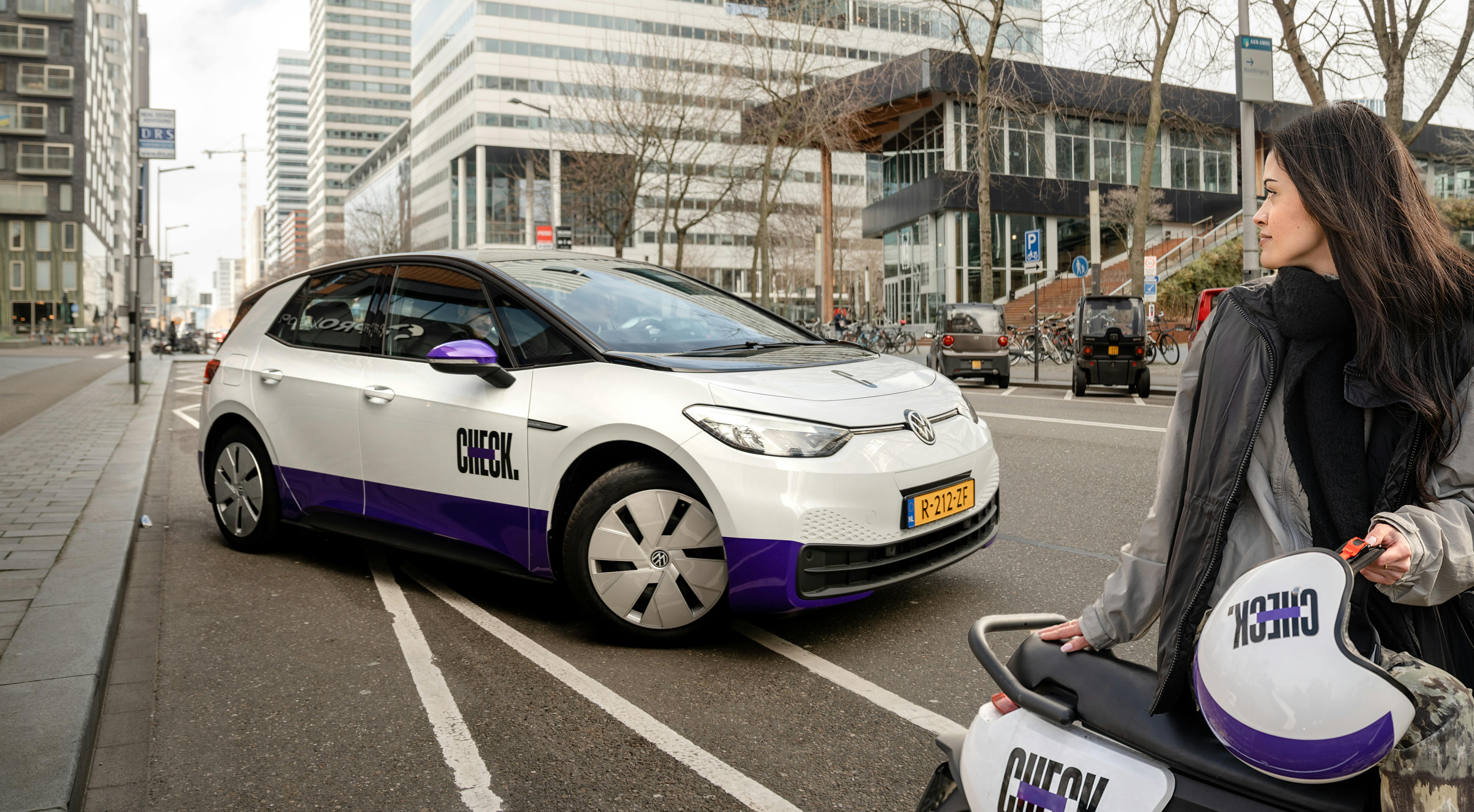
Check e-mopeds on Amsterdam streets — NL shared mobility market leader
Check — NL shared mobility · ridecheck.app
Executive summary

NL urban transport is three separate businesses — e-mopeds, micro-mobility, and shared cars — each with its own operators, funding model, and city contract structure. No single company spans all three.

Three segments shape NL shared mobility — e-mopeds, municipal micro-mobility, and shared cars — and each operates under distinct economics, city concession requirements, and demand patterns. E-moped operators compete on urban density and trip frequency. Municipal micro-mobility players win or lose on European-scale city tender bids. Shared cars generate revenue through hourly bookings, B2B fleet contracts, and NS rail partnerships. No single operator has built a profitable position across all three simultaneously in the Netherlands.

E-mopeds — Check leads
Check holds 75% of NL e-moped market and reached profitability in 2024 (€18M revenue, 8% EBIT). Cooltra/felyx holds the remainder after the 2024 merger. This segment grew from zero in 2020 and is now effectively closed to new entrants.
Municipal micro-mobility — TIER-Dott
TIER-Dott operates e-bikes and e-scooters across 400+ cities on city contracts. NL is one market in a European-scale operation. The 2024 merger created a cost base smaller operators cannot match on municipal bids.
Shared cars — Greenwheels & MyWheels
Greenwheels (3,500 cars, Volkswagen-backed) and MyWheels (2,729 cars, cooperative) serve different needs. Greenwheels covers 195 NS rail stations. MyWheels is 50% electric and running a Vehicle-to-Grid pilot in Utrecht. Both are expanding through 2026.
Where this is heading: Dutch municipalities are moving toward MaaS (Mobility-as-a-Service) — integrated platforms where a single app covers public transport, e-mopeds, e-bikes, and shared cars. Operators that connect to NS rail and 9292 public transport data are positioned to win city contracts in this model. Check already reports 1 in 3 rides connecting to a public transport journey. Greenwheels is at 195 NS stations. The operator that builds the transit integration layer first shapes the next phase of NL urban mobility.
Check 2024 Revenue
€18M
Profitable. EBITDA €1.8M (10%). NL moped market leader. Check Annual Report 2024
Check NL Moped Market Share
75%
Up from 58% in prior year. 4.2M rides, 12.2M km in 2024. Check Annual Report 2024
Cooltra Group Revenue 2024
€60M
+32% YoY. Includes felyx NL operations across 15+ cities. Cooltra 2024 Results
TIER-Dott Combined Revenue
€250M
125M+ annual trips. Dott HQ Amsterdam since 2019. TIER-Dott Merger Press Release
01
Market overview
Five operators — revenue, fleet, and city footprint
Covering e-mopeds, e-bikes, e-scooters and shared cars. Each operator runs a distinct model: municipal tender, B2C subscription, B2B fleet, or station-based sharing.
Operator Founded / HQ Founders Key investors Vehicle type NL cities Fleet (NL / Group) Revenue Status
Check 2020 / Amsterdam Thijn van Helvoirt, Paul van Merrienboer, Marco Knitel Slingshot Ventures, Ponooc (€10M, 2022) E-moped, e-bike, e-car 20+ 5,000 mopeds · e-bikes (pilot phase, 2024) · 50 e-cars (targeting 100+ mid-2025) ~€18M (2024) Profitable
Cooltra / felyx 2017 (felyx, AMS) / Barcelona Felyx: Quinten Selhorst, Maarten Poot Felyx: ABN AMRO, De Hoge Dennen, Anne-Marie Rakhorst (~€24M Series A · ~$31M total) E-moped, e-scooter, e-bike 15+ ~1,500 Rotterdam + 11 NL cities €60M group (2024) EBITDA positive since 2019
TIER-Dott 2018/2019 / Berlin & Amsterdam TIER: Lawrence Leuschner / Dott: Henri Moissinac, Maxim Romain Pre-merger investor details not disclosed in merger press release E-bike, e-scooter Multiple 250,000 vehicles in 20+ countries €250M group (2024) Merged March 2024
MyWheels 1993 / Amsterdam Henry Mentink (founded as Wheels4all) The Sharing Group (private, cooperative structure) Electric car 80+ 2,500+ cars NL Not disclosed NL car sharing market leader
Greenwheels 1995 / Amsterdam Gijs van Lookeren Campagne, Jan Borghuis Volkswagen Financial Services & Pon Holdings (acquired 2012) Car (incl. EV) 200+ 3,500 cars at 200+ NL locations Not disclosed Expanding to 4,000 vehicles by 2026
Sources: Check Annual Report 2024 · ImprovedCF (founders) · Tracxn (Marco Knitel, co-founder) · Cooltra 2024 Results · Silicon Canals (felyx investors) · TIER-Dott Merger, March 2024 · The Sharing Group Press Release · Greenwheels About · Wikipedia (Greenwheels history)
02
Demand & fleet growth
NL shared mobility fleet by segment — 2025
Fleet size is the most consistent publicly available proxy for demand. Car sharing and e-moped segments each hold approximately 5,800–6,500 vehicles in the Netherlands. Car sharing population penetration rose from 4% to 7% in a single year (fresk.digital, 2023). MyWheels serves 190,000+ active users (The Sharing Group, 2022). Greenwheels grew from 1,700 vehicles in 2010 to 3,000 in 2025. E-moped segment-level user data is not published publicly.
NL shared vehicle fleet by segment — 2025
Shared cars ~5,800 E-mopeds ~6,500 E-bikes 1,400+ 0 1,500 3,000 4,500
Shared cars: Greenwheels 3,000 · MyWheels 2,729    E-mopeds: Check 5,000 · Cooltra/felyx NL ~1,500    E-bikes/scooters: Cooltra/felyx NL 1,400 · TIER-Dott NL (fleet not disclosed)
NL car sharing fleet growth — Greenwheels milestones 2010 → 2025
2010 1,700 vehicles 2015 2,000 vehicles 2025 3,000 vehicles +76% since 2010
Source: Greenwheels — History, 30th anniversary 2025 (milestone fleet data). Current fleet: 3,500 vehicles per Greenwheels About page.
7%
NL population using car sharing
Up from 4% — a single year increase. Higher in Amsterdam and Utrecht. Source: fresk.digital, 2023
7,920
NL shared cars total fleet
+23% in 2023 alone. Approx. half are electric. Source: fresk.digital, 2023
190K+
MyWheels active users
NL market leader by fleet. 50% of fleet now electric. Source: The Sharing Group, 2022
$3.8B
NL shared mobility market 2025
Projected $8.99B by 2032 at 13.1% CAGR. Source: MarkNtel Advisors 2025
E-moped demand: built from zero in four years. Check launched with 160 e-mopeds in Rotterdam in February 2020. By end of 2024 the fleet reached 5,000 across 20+ NL cities — a 3,025% increase. Revenue grew by 700% in 2021 alone and reached €18M in 2024 with an 8% EBIT margin. The e-moped segment did not exist at scale in the Netherlands before 2020.
Sources: Check Annual Report 2024 · Check newsroom (Feb 2025: "Check closes 2024 with a profit")
03
Operator profiles
Business model, scale, and operational footprint
Check
ridecheck.app · Amsterdam, 2020
Revenue 2024~€18M (EBITDA €1.8M / 10% · EBIT €1.4M / 8%) Revenue 2022€17M (trips doubled: 3.2M → 6.3M) Revenue 2021~700% growth vs. 2020 (launch year) Fleet5,000 e-mopeds · e-bikes (pilot phase, 2024) · 50 e-cars (targeting 100+ mid-2025) Cities20+ NL cities + Düsseldorf (DE) Rides4.2M rides · 12.2M km in 2024 Market share75% of Dutch shared moped market Funding€10M (Feb 2022, Slingshot Ventures & Ponooc) PartnersNS, ANWB, 9292, Shuttel (B2B)
Launched February 2020 in Rotterdam. Scaled to 20+ NL cities, e-bikes (2025), and shared cars (Amsterdam, 2024). 1 in 3 trips start or end at a public transport node. Reward system (Coins) reduced misparked moped complaints measurably. Corporate mobility via Shuttel adds a B2B revenue layer alongside the consumer app.
Cooltra / felyx
cooltra.com · Barcelona / Amsterdam
Group revenue€60M (2024, +32% YoY) B2C revenue€45M (+42%) B2B revenue€14.5M (+4%) Group fleet16,000+ electric vehicles Group rides8.7M in 2024 NL citiesAmsterdam, Rotterdam, The Hague, Groningen, Eindhoven, Delft + 9 more Rotterdam1,500 e-scooters, contract through 2030 Countries6 countries, 23 cities
Felyx, founded in Amsterdam (2017), merged with Spanish operator Cooltra in March 2024. The combined group holds 50%+ market share in operating cities and 42% European-wide. 1,400 shared e-bikes deployed across NL cities post-merger. EBITDA positive since 2019.
TIER-Dott
ridedott.com · Berlin / Amsterdam
Group revenue€250M (2024) Annual trips125M+ Rides (2024)100M Users10M Fleet250,000 vehicles Footprint400+ cities, 20+ countries Employees1,900 across 100 operational centres MergerTIER + Dott completed March 2024
Dott was founded in Amsterdam in 2019 and maintains its HQ there. TIER (Berlin, 2018) and Dott merged in March 2024 to form the declared "European champion of shared micro-mobility." Operates exclusively on city concessions — no consumer free-float without municipal approval. Focuses on e-bikes and e-scooters; no mopeds.
MyWheels
mywheels.nl · Amsterdam (The Sharing Group)
PositionNL car sharing market leader Fleet2,500+ cars (over 50% electric) Cities80+ NL cities and towns RevenueNot publicly disclosed ParentThe Sharing Group AcquisitionsJuuve (2021), ConnectCar (2022) InnovationEurope's first Vehicle-to-Grid (V2G) car sharing service (Utrecht, Nov 2024) with Renault & We Drive Solar
Market leader in Dutch shared car segment. Serves Amsterdam, Rotterdam, Utrecht, The Hague and 75+ smaller cities. Partnership with NS since founding — interoperable with public transport. Utrecht V2G pilot (November 2024): 500 Renault 5 E-Tech electric vehicles feeding energy back to the grid.
Greenwheels
greenwheels.com · Amsterdam, founded 1995
Fleet3,500 cars · targeting 4,000 by end of 2026 Cities200+ towns and cities across NL Stations195 NS train station locations NS partnershipSince 1997 RevenueNot publicly disclosed ModelStation-based B2C + B2B
The oldest operator in the NL market. Station-based model (fixed parking spots at NS stations) differs fundamentally from free-float competitors. Each Greenwheels vehicle is calculated to replace 14 privately owned cars. Averaging 4.5 hours of daily usage per vehicle. Recognised as Netherlands' most inspiring company 2022–2024. Awarded to anyone 18+ with a driving licence — no app needed for booking at stations.
04
Market dynamics
Operational complexity driving consolidation
Shared mobility in the Netherlands is operationally intensive: multi-city permit negotiations, 24/7 fleet maintenance, damage and parking enforcement, and the need to balance unit economics against city concession requirements.
Sector dynamics
Where shared mobility operators win and where they struggle
Operational challenges
  • City concession risk — each municipality sets its own permit conditions, fleet caps, and service zone requirements
  • Fleet maintenance at scale — e-mopeds and e-bikes require daily rebalancing, charging, and repair across 20+ cities
  • Parking enforcement — user behaviour (misparking) generates fines and city friction; Check's Coins reward system reduced complaints measurably
  • Unit economics pressure — vehicle depreciation, insurance, and battery replacement require high utilisation to break even
  • Multi-modal integration — 1 in 3 Check trips connects to public transport; NS and 9292 partnerships require operational alignment
  • B2B complexity — corporate mobility programmes (Shuttel, ANWB) add invoicing, SLA management, and reporting layers
Structural opportunities
  • Transit integration — operators connecting to NS and 9292 capture commuter demand that pure free-float misses
  • Multi-modal expansion — Check's move from mopeds to e-bikes and cars increases revenue per user and reduces churn
  • V2G and grid services — MyWheels/Renault Utrecht pilot signals a new revenue stream: electric fleets as grid assets
  • Corporate mobility — Shuttel, ANWB, and business accounts generate predictable recurring revenue alongside volatile consumer demand
  • Post-merger integration — felyx/Cooltra and TIER/Dott created scale advantages in city negotiations; smaller NL operators face consolidation or exit
  • NL regulatory tailwind — Dutch municipalities actively co-design shared mobility zones, creating more stable concession environments than most European cities
trendsonfire.com
05
Strategic analysis
Five M&A scenarios for Check
Check is the only NL operator that reached profitability at scale in the e-moped segment. The next phase — expanding city coverage, adding vehicle categories, and competing for MaaS platform position — is likely to require inorganic moves. Five scenarios are credible based on the current market structure. No deal activity is reported or implied.
01 — NL Market Consolidation
Cooltra/felyx NL e-moped operations
Check holds 75% of the NL moped market. Cooltra (Barcelona) operates felyx across 6 countries; NL is a minority piece of their portfolio. Acquiring felyx NL's fleet and city permits would push Check's moped share above 90% and remove its only direct Dutch competitor.
What it unlocks: full pricing power in the moped segment, lower customer acquisition cost, accelerated city expansion using felyx permits already in place.
Complexity: Medium — requires Cooltra NL asset carve-out
02 — Category Extension
An established NL car sharing operator
Check launched its shared car service in Amsterdam in 2024, with 50 e-cars and a target of 100+ by mid-2025 (Annual Report 2024). Acquiring an existing operator rather than building organically is the faster path — the playbook the sector has already used: MyWheels acquired Juuve (2021) and ConnectCar (2022) to scale from ~1,500 to 2,500+ cars in two years. Two operators cover the NL car sharing market: MyWheels (2,729 cars, 190,000+ registered users) and Greenwheels (3,500 cars, 195 NS stations). Either would give Check an immediate multi-modal fleet without building from scratch.
What it unlocks: immediate car sharing fleet, app consolidation, route optimisation across mopeds and cars, higher revenue per user through a single session.
Complexity: Medium — fleet integration, permit and insurance transfer
03 — Municipal Footprint
TIER-Dott Dutch city concessions
TIER-Dott merged in March 2024 and is rationalising a 400-city portfolio across 20 countries. If they reduce their NL municipal footprint, Check is a natural buyer for NL city contracts and e-bike assets. This would add the e-bike and e-scooter concession segment to Check's portfolio without tendering from scratch.
What it unlocks: city concession rights, e-bike fleet, established municipal relationships in cities where Check has not yet won a concession.
Complexity: Low–Medium — depends on TIER-Dott portfolio decisions
04 — MaaS Platform Position
A corporate mobility or MaaS aggregation platform
Check already integrates with Shuttel (B2B), ANWB, NS, and 9292. 1 in 3 Check rides connects to public transport. Acquiring a corporate mobility platform or MaaS aggregator would let Check become the integration layer across operators — rather than one operator inside a platform another company controls.
What it unlocks: platform revenue alongside operator revenue, deeper NS and municipality partnerships, B2B contract stickiness.
Complexity: High — platform integration, multi-operator coordination
05 — Vertical Integration
E-vehicle maintenance, battery servicing, or charging infrastructure
Check's 5,000 e-mopeds require continuous rebalancing, charging, and repair across 20+ cities. Fleet operational cost is the primary squeeze on unit economics at scale. An 8% EBIT margin is strong for the sector but thin enough that third-party servicing costs can erode it as the fleet grows. Acquiring an e-vehicle service operator or battery swap provider reduces dependency on external contracts and improves fleet uptime — the single biggest driver of revenue per vehicle per day.
What it unlocks: lower per-vehicle operational cost, faster vehicle turnaround, a proprietary charging network that raises the barrier for new entrants.
Complexity: Medium — operational integration, depends on current fleet ownership and servicing model
Sources for M&A analysis: Check Annual Report 2024 · TIER-Dott Merger Press Release, March 2024 · The Sharing Group Newsroom · Cooltra 2024 Annual Results
About the Author

TrendsOnFire is a AI based market intelligence platform publishing editorial analysis on retail, technology, supply chain, people and transformation trends across Europe.

Created by Olga Bressers, a senior executive with experience in commercial & digital operations, ecommerce, omni-channel strategy, operations, programs and business transformation.

Contact →