People & Transformation — Tech Recruitment Intelligence
US AI roles up 134%. Dutch ICT vacancies fell to 16,700. Tech hiring has fractured — in every market.
In the US, AI-related job postings are 134% above pre-pandemic levels while general tech postings sit 34% below. In the Netherlands, ICT vacancies fell to 16,700 in Q1 2026. In Europe, 57.5% of businesses cannot fill ICT vacancies. The pattern is the same everywhere: AI-specialised roles are accelerating while generalist tech contracts. This report covers all three markets — US data (Sections 01–02), European view (Section 03), Netherlands view with UWV data (Section 04) — plus the 38.5% of candidates now cheating on technical assessments.
76% of large companies are hiring a Chief AI Officer. 25% of their employees use AI daily. The gap between those two numbers is where the next wave of promotions happens.
76%
CEOs at large companies now have or are hiring a Chief AI Officer
In 2024, that figure was 26%. The CAIO went from niche to standard in 24 months — faster than any executive role in history
The comparison to the CISO is exact: the Chief Information Security Officer was invented when the internet created a threat category that no existing executive owned. AI is doing the same to strategy, operations and every function in between
40% of CAIOs report directly to the CEO. No playbook exists yet — the first person to define what the role looks like inside a given company wins by default
Point gap between employees who have the skills and those who use AI daily
86% of employees at these companies already have the skills to use AI, or could pick them up with minimal training
25% actually use AI tools in their daily workflow. The shortfall is not a skills problem — it is a change management problem
Nobody is building the bridge from "we have the capability" to "we are saving 40 hours a week." Whoever builds that bridge, in any function, gets promoted
Of Chief AI Officers were promoted from inside — not hired from outside
In a separate IBM study of 600 CAIOs, 57% were internal employees who already had the job before there was a title for it
85% of CEOs say every functional leader — CMO, CFO, COO, head of sales — must become a tech expert. 77% say talent leadership and tech leadership roles are converging into one job
"You do not need to change your role. You need to change which version of your role you are." The AI-native version of any function is the seat that opens next
The cuts in tech are not random. They follow a pattern: any role where the primary output can be generated, accelerated, or replaced by AI is contracting. Entry-level coding, IT support, and manual QA are the clearest examples. These are not temporary post-pandemic corrections — the Bureau of Labor Statistics projects Computer Programmers down 6% over the decade to 2034.
Shrinking — fewer postings, lower pay, AI displacement
Computer Programmer
AI code generation replacing routine development work
−6% (BLS 2024–2034)
IT Support Specialist
AI-powered helpdesks handling tier-1 and tier-2 tickets
Declining (BLS)
Entry-Level Software Engineer
Junior coding tasks absorbed by GitHub Copilot, Cursor, Claude Code
−30% postings YoY
Manual QA / Test Engineer
Automated testing and AI test generation absorbing manual work
Fewer open roles
General Software Engineer
Broad-skill postings without AI specialisation falling fastest
−34% vs 2020 baseline
Booming — highest demand, fastest salary growth
AI / ML Engineer
#1 fastest-growing role in the US and across Europe (LinkedIn Jobs on the Rise 2026)
+181% skills YoY
Information Security Analyst
Cybersecurity threat surface expanding with AI adoption
+29% (BLS 2024–2034)
Data Engineer / Data Scientist
45% of data & analytics postings now contain AI terms
Strong growth
AI Product Manager
Bridge role: technical understanding + business strategy
Emerging fast
Cloud / DevOps + AI Integration
MLOps, LLMOps, AI infrastructure — specialist demand
The structural read: The market is not contracting — it is concentrating. Total US tech employment is 9.6 million workers and expected to grow 2× faster than the overall US workforce over the next decade (CompTIA 2025). But the growth is almost entirely in AI-specialised roles. Median tech salary sits at $112,667 — double the national median. The premium, however, now belongs almost exclusively to candidates who can demonstrate AI skills alongside their technical domain.
02
US Market — The Divergence in Numbers
US tech hiring: two completely different directions.
The Dice Tech Job Report (April 2026) and Indeed Hiring Lab data — both covering the United States — show a market split not seen in a previous hiring cycle. AI fluency is no longer a premium differentiator: it has become a baseline expectation in 71% of US tech job postings. European and Netherlands data follows in Sections 03 and 04.
Tech Job Postings vs. Pre-Pandemic Baseline (Feb 2020 = 0%)
AI skills now appear in 71% of US tech postings, up 181% year-on-year. Tech job postings grew 21% year-on-year in April 2026 — the strongest gain of 2026. Finance/banking (+34%) and aerospace/defence (+30%) led sector growth month-on-month.
9.6 million tech workers in the US. Median salary $112,667 — 2× the national median. Nearly 125,000 active AI job postings as of May 2025. Tech occupations projected to grow at twice the rate of the overall US workforce over the next decade.
Europe: 10 million ICT specialists. Half the 2030 target. AI Engineer the fastest-growing role in every major market.
Eurostat counts 10.3 million people employed as ICT specialists across the EU in 2024 — 5% of the total workforce, up from 3.4% in 2014. The EU's Digital Decade target is 20 million ICT specialists by 2030. At current trajectory, Europe will reach roughly 12 million. The gap: 8 million.
EU ICT specialists employed (2024)
10.3M
Eurostat, 2024 — 5% of EU workforce; up from 3.4% in 2014
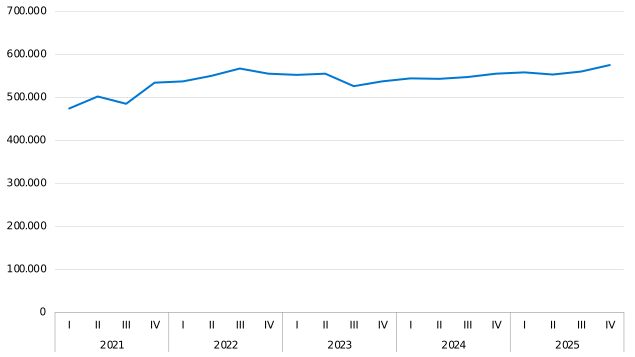
NL: 575,000 ICT professionals. Vacancies declining since 2023. AI Engineer the #1 growing role.
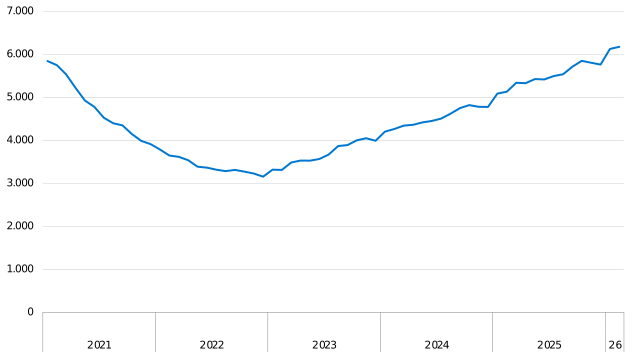
The Dutch ICT job market went through three distinct phases: explosive growth (2021–2022), a sharp reversal (2023–early 2025), and a partial recovery from mid-2025. Unemployment among ICT professionals reached ~6,200 by February 2026 — concentrated in the 27–50 age bracket, driven by banking sector reorganisations and AI-related productivity gains reducing headcount needs.
Data below sourced from UWV Arbeidsmarktinformatie — ICT sector (Uitvoeringsinstituut Werknemersverzekeringen, the Dutch Employment Insurance Agency). UWV publishes quarterly ICT labour market updates drawing on CBS vacancy surveys and benefit payment records. uwv.nl/ict →
ICT professionals in NL (end 2025)
575K
UWV, Q4 2025 — 38% in information & communication sector; 62% in other industries
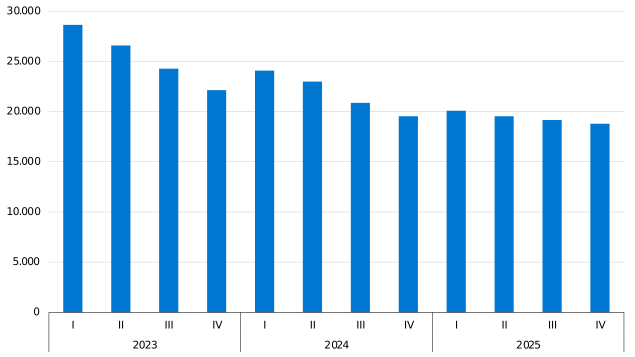
Open ICT vacancies — Q1 2026
16,700
CBS, Q1 2026 (info & comm sector, seasonally adj.) · UWV Q4 2025: ~18,800 across all sectors
ICT professionals unemployed (Feb 2026)
6,200
UWV, Feb 2026 — up from 5,300 in April 2025; concentrated in ages 27–50
Softwareontwikkelaars — HBO/WO level — fastest WW growth despite high demand. AI code generation absorbing junior and mid-level workload.
Rising fast
Systems Designer / Architect
Systeemontwerpers en -architecten — senior role affected by banking sector reorganisations and reduced tech headcount across Dutch financial services.
Rising fast
Security Specialist
Securityspecialisten — paradox: structural shortage AND rising unemployment. Budget cuts affecting security teams despite rising threat surface.
Rising fast
Servicedesk / Support (MBO level)
Growing more slowly than HBO/WO roles — AI helpdesks absorbing tier-1 and tier-2 support tickets at scale.
Growing slower
Fastest-growing NL roles (LinkedIn Jobs on the Rise 2026)
AI Engineer
#1 fastest-growing role in the Netherlands — 2.8 years median experience, 44% hybrid. Top regions: Randstad, Brabant, Groningen.
#1 NL 2026
Cloud / DevOps Engineer
Infrastructure automation and MLOps demand continues to grow as Dutch enterprises migrate to cloud and integrate AI workloads.
Strong demand
Data Engineer / Analyst
Data pipeline and analytics roles remain in demand — 45% of NL data postings now include AI terms (aligned with EU-wide trend).
Strong demand
Cybersecurity Specialist
Zero Trust, identity management, AI-aware security in demand — structural shortage persists despite rising WW numbers.
Structural shortage
Sources: UWV — Meer ICT'ers in WW ondanks krappe arbeidsmarkt (software developers, security specialists, systems architects named as roles with fastest WW growth). LinkedIn — Jobs on the Rise 2026, Netherlands (AI Engineer #1). Note: UWV does not publish a full role-by-role breakdown in its public dashboard; the four roles above are explicitly named in UWV's published analysis.
What the Dutch data shows: The NL ICT market peaked in mid-2022 — roughly 40,000 open vacancies, near-zero unemployment, a shortage ratio that made every tech recruiter's pipeline feel impossible. Since 2023, supply and demand have been converging. Vacancies fell to 18,800 (Q4 2025). Unemployment rose to 6,200 (Feb 2026). The shortage has not disappeared — UWV still classifies ICT as a structurally tight market — but the emergency conditions of 2021–2022 are over. The shift is concentrated in mid-career professionals aged 27–50, driven by two forces: banking sector reorganisations across Dutch financial services and AI tools absorbing work that previously required dedicated junior or mid-level engineers.
Dutch tech employer layoffs — the companies behind the numbers
Four Dutch tech-sector employers that announced significant restructuring since 2024 — cuts concentrated in engineering, R&D, and technology functions, verified from official sources.
Booking.com
1,000+
jobs cut in NL · product, engineering & ops
Announced November 2024 as part of a "Transformation Program". Amsterdam workforce cut by 10% in April 2025 — approximately 900 NL employees. Second wave: hundreds more in July 2025. Cuts targeted product management, engineering, and operations. Reason: AI reducing the headcount needed to operate at scale.
Announced January 28, 2026 — despite ASML recording its best-ever year in 2025 (€31.7B revenue, €9.6B net profit). Cuts target technology and IT divisions. CEO explained the need to "restore the fast-moving culture which made us so successful." ASML employs 43,500 globally, the majority of its Dutch workforce in Veldhoven.
Ongoing restructuring since 2023, with 700 more NL jobs cut than initially announced. Cuts include R&D roles at the central research lab (Natlab, Eindhoven), engineering and technology positions across multiple business units, and ~400 production roles in Drachten relocated to Indonesia and China. Philips employed ~11,000 in the Netherlands when the restructuring began.
Announced July 1, 2025. Represents nearly 10% of TomTom's global workforce of 3,700 — of which 1,200 work in the Netherlands. Cuts target application layer development, sales, and customer support. CEO Harold Goddijn: AI enables a modernised technology stack that "shortens implementation cycles". The company reported a €14 million loss in 2024.
The pattern: Booking.com, ASML, Philips, and TomTom cut a combined 5,600+ roles across their NL operations since 2024 — all tech-sector employers, all citing AI, operational efficiency, or platform modernisation as the primary driver. The cuts fall directly in the engineering and R&D talent pool that Dutch tech recruiters compete for. Adyen reported no layoffs — the fintech has been profitable since before its IPO and continues to hire.
All figures: bruto jaarsalaris (gross annual, EUR) · excludes bonus, company car, pension · financial services / consultancy typically 10–20% above; non-profit / education 10–15% below
Role
Junior
Medior
Senior
Lead / Director
Cloud Engineer
€48–58K
€65–85K
€90–115K
€120–145K
DevOps Engineer
€50–60K
€68–88K
€95–120K
€125–150K
Data Engineer
€48–60K
€68–88K
€95–118K
€120–145K
Security Engineer
€52–64K
€72–92K
€100–130K
€135–170K (CISO)
IT Architect
—
€80–100K
€105–135K
€140–180K
IT Manager
—
€75–95K
€100–130K
€140–180K
Business Analyst
€42–52K
€58–75K
€80–105K
€110–135K
Functioneel Beheerder
€38–48K
€52–68K
€72–92K
€95–120K
IT Director / CIO
—
—
€140–180K
€180–250K+
Source:De ICT Recruiter — IT Arbeidsmarkt 2026, bijgewerkt april 2026. Data based on UWV Spanningsindicator IT-arbeidsmarkt 2025–2026, Computable salarisrapport, and De ICT Recruiter own placements (100+ trajectories, Q1 2026). Figures are gross annual EUR, excluding bonus, car and pension. C-level roles typically include 15–30% variable bonus on top of the listed base.
Ravio 2026 · Ireland mid-level: €75.5K · NL at €76K ranks 10th of 53 countries
Source:Ravio Netherlands Salary Benchmarks 2026 — 1,700+ companies, 1,875 benchmarks, 300 job roles benchmarked. Data drawn from HRIS integrations verified by Ravio benchmarking team. Note: Ravio covers tech-company roles specifically; traditional corporate IT roles may differ.
05
The Skills Verification Crisis
Candidates are using AI to write CVs, prepare interviews, and answer live assessments — and the data shows it is working.
Candidates are using AI across every stage of the hiring process — and the data shows that the line between "AI-assisted" and "AI-impersonating" has already been crossed at scale. By January 2026, 38.5% of tech candidates showed detectable signs of AI cheating during live technical interviews. In purely technical roles, it was 48%. And 61% of those candidates still passed.
AI Cheating Rate in Tech Interviews — Monthly Trajectory (2025)
Cluely is one of several dedicated tools — alongside Interview Coder — purpose-built to provide real-time AI answers during live video interviews. The tool runs invisibly alongside any video call. Dedicated AI interview tools as a category account for 45% of all detected cheating cases in technical interviews, according to the Fabric study. cluely.com
How candidates cheat — breakdown by method
Source: Fabric, 19,368 interviews — July 2025 to January 2026
45%
Dedicated AI interview tools
Cluely, Interview Coder — purpose-built apps that run invisibly alongside video calls and generate real-time answers
34%
Voice-mode LLMs
ChatGPT, Claude, Gemini in voice mode — candidate speaks the question aloud and relays the AI's spoken answer
18%
Tab switching / second screen
Classic method — paste question into ChatGPT in another tab or on a second monitor, copy the answer back
3%
Live human assistance
Another person — colleague, friend — follows the interview on a separate device and provides answers in real time via chat
Three numbers that define the verification problem
The CV, the interview and the assessment — all compromised at scale
84%
Developers using AI tools
84% of developers use or plan to use AI tools — up from 76% in 2024. The majority use them daily. Separating AI-augmented work from AI-generated work is the core hiring challenge.
61% of candidates who showed AI cheating signs still passed the assessment with a score of 7.0 or above and advanced to the next stage. The cheating is not being caught — it is being rewarded.
Junior candidates (0–5 years experience) cheat at twice the rate of senior developers. The entry-level pipeline — already shrinking as companies cut junior roles — now carries an additional trust problem for the candidates who remain.
84% of developers use AI tools — but trust is falling and two thirds report frustration with the results.
The Stack Overflow Developer Survey 2025 surveyed tens of thousands of developers worldwide on AI tool adoption. The picture is more nuanced than the headline numbers suggest: usage is near-universal, but trust and satisfaction are falling as developers hit the real limits of AI code generation.
Stack Overflow Developer Survey 2025
84% of developers use or plan to use AI tools (up from 76% in 2024). Positive sentiment fell from 70%+ in 2023–2024 to 60% in 2025. 66% cite "almost right but not quite" AI solutions as their primary frustration. Only 3.1% highly trust AI tool accuracy.
As AI capabilities grow, the gap between what candidates claim and what they can demonstrate in practice is widening. Dice's Trust Gap study tracks how hiring managers are adapting verification methods in response — from take-home projects to live coding with commentary.
Source:Stack Overflow Developer Survey 2025. Note: "Positive sentiment" covers "very favorable" (22.9%) + "favorable" (36.8%). Sentiment was 70%+ in both 2023 and 2024; the 2025 drop to 60% is the first meaningful decline since AI tools entered mainstream developer use.
07
Recruiter Response
How companies are rebuilding the verification layer
The answer is not to ban AI from hiring — it is to design assessments that cannot be gamed by AI alone. The most effective approaches combine take-home tasks (which test output quality) with live explanation sessions (which test understanding). The gap between what AI can generate and what a candidate can explain is where genuine skill shows up.
Method
How it works
What it tests
Adoption
Take-home project + live defence
Candidate completes a task offline, then presents and defends their decisions in a live session with the hiring panel
Genuine understanding — candidates must explain trade-offs, not just produce output
41% of companies
AI-augmented coding with commentary
Candidate codes live but is explicitly allowed to use AI tools — the assessment scores reasoning and tool use, not memorisation
How the candidate uses AI — prompt quality, validation behaviour, debugging approach
Growing fast
Behavioural-plus-technical pairing
Technical assessment combined with structured behavioural questions about real past projects — requires specific, personalised answers AI cannot fake
Genuine experience — vague or generic answers flag candidates who cannot reference real work
Standard practice
AI detection tooling
Platforms like HackerRank flag real-time tab switching, keystroke patterns, and LLM-like response cadences during online assessments
Detection — reported 93% accuracy rate for HackerRank's plagiarism detection
68% use take-home tests as response
Skills-based hiring — no CV required
Role is posted with a structured skills task rather than a CV screen. Candidate's first submission is work output, not a document
Actual capability from the first touchpoint — CV inflation and AI-written summaries become irrelevant
The strategic question for 2026: If 84% of developers are using AI tools daily, the goal is no longer to find candidates who work without AI — it is to find candidates who work well with it. The best technical assessments now measure judgment, not recall: can the candidate evaluate AI output, catch its errors, and direct it toward the right solution? That skill is rare and genuinely verifiable. The 66% of developers who say AI solutions are "almost right but not quite" are the people who know the difference.
TrendsOnFire is a AI based market intelligence platform publishing analysis on retail, technology, supply chain, people and transformation trends across Europe.
Created by Olga Bressers, a senior executive with experience in commercial & digital operations, ecommerce, omni-channel strategy, operations, programs and business transformation.