Brand Intelligence — Home Appliances & Professional Equipment

Miele: €5.16 billion in revenue and 125 years of unbroken family ownership

The German premium appliance manufacturer founded in 1899 in Herzebrock — still 100% owned by the Miele and Zinkann families — with 19 production plants, 49 subsidiaries, and a global digital hub, Miele X, based in Amsterdam since 2020.

Sources: Miele.com, Invest in Holland, Miele-X.com, EcoVadis, Neocom.ai, iamexpat.nl Updated 7 June 2026
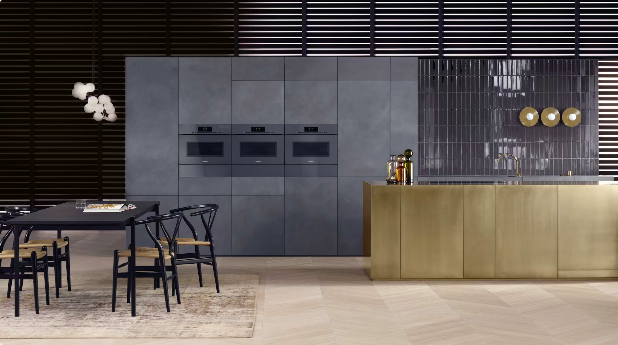
Miele built-in appliances in a luxury kitchen
Revenue Business Year 2025
€5.16B
Full-year turnover for the 2024 business year, ~23,000 employees. Source: Miele.com — Business Development
Employees Globally
~23,000
Across 19 production plants and 49 service and sales subsidiaries worldwide. Source: Miele.com — Business Development
Sales Subsidiaries
49
Company-owned subsidiaries in ~50 countries; products available in approximately 100 countries worldwide. Source: Miele.com — Production Sites
Founded
1899
By Carl Miele and Reinhard Zinkann in Herzebrock, Germany. Still 100% family-owned by their descendants. Source: Miele.com — History
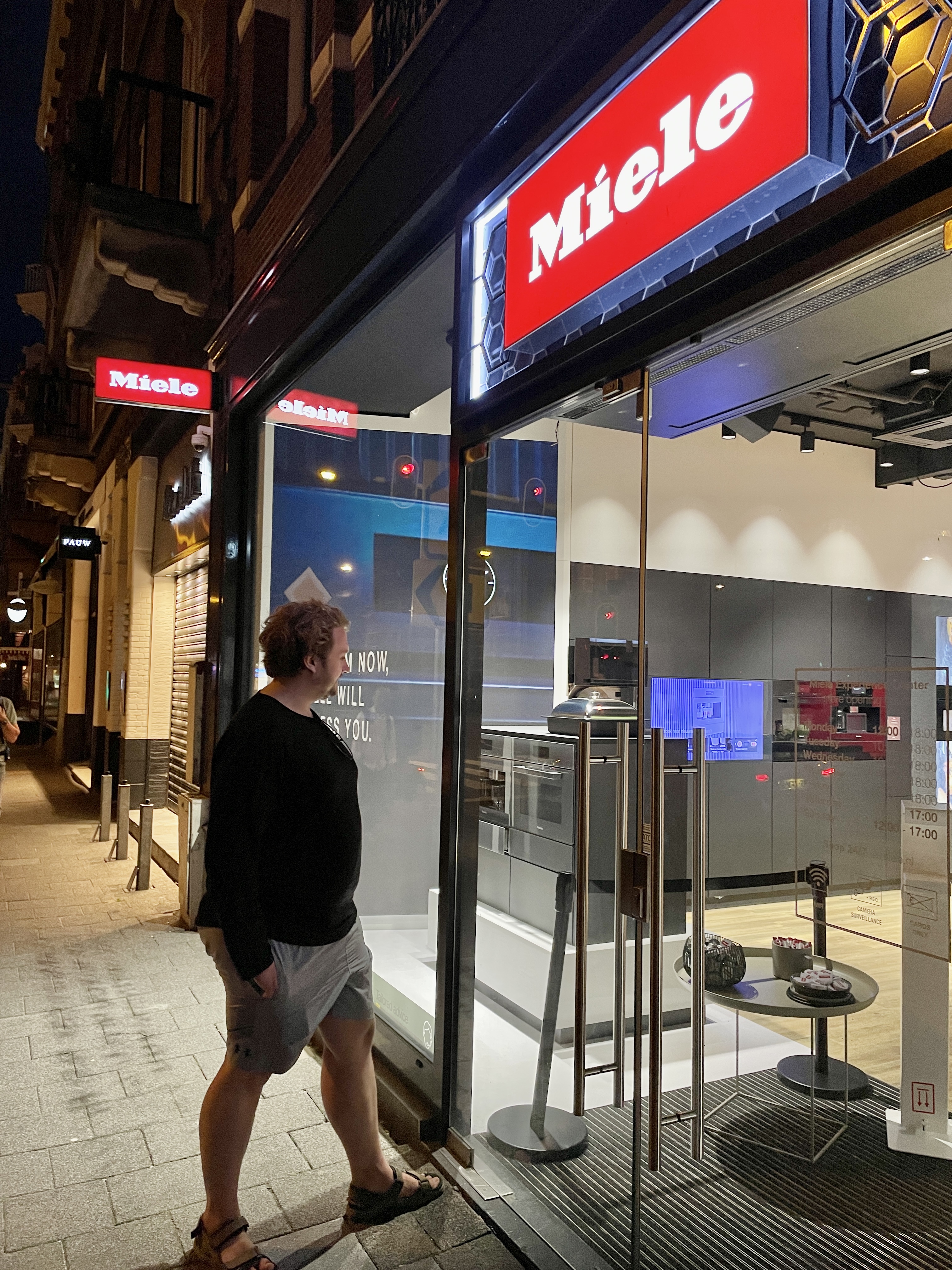
Miele store Amsterdam
Brand Intelligence — Why It Works
3 principles making this brand successful
Miele
01
125 years of family ownership — infinite time horizon
  • Miele family holds 51.1%; Zinkann family holds 48.9% — all ~80 family stakeholders are direct descendants of the 1899 founders
  • No external shareholders, no IPO pressure — capital allocation follows long-term quality commitments over short-term returns
  • Products are tested for 10,000 hours simulating a 20-year lifespan — Miele's official engineering standard, not a marketing claim
02
Direct customer ownership — selling without retailer intermediaries at scale
  • ~47 direct webshops across Europe, Americas, Asia-Pacific and Africa — Miele owns the customer relationship, the transaction, and the data
  • AI Product Adviser generates 9% of total online sales at 2× the conversion rate of standard sessions (up from 7.2% within one year)
  • Miele X, launched July 2020 in Amsterdam, is the dedicated entity built to grow the direct channel globally
03
Professional division — B2B revenue beyond the consumer appliance cycle
  • Miele Professional serves hospitals, research laboratories, dental practices and commercial catering — institutional buyers with procurement cycles independent of consumer trends
  • Products span commercial dishwashers, laboratory reprocessing equipment, medical instrument processing and industrial parts cleaning
  • EcoVadis Gold Medal: 84/100 (top 2% globally), 96/100 in the environment category — third-party verified sustainability standing
01
Company Origins
Founded in Herzebrock in 1899 — cream separators, then centrifuges, then appliances for life

Miele was founded on 1 July 1899 by Carl Miele, an engineer, and Reinhard Zinkann, a businessman, in an old saw and corn mill in Herzebrock, near Gütersloh in Westphalia, Germany. Their first product was a cream separator — agricultural equipment, not domestic appliances. The partnership structure they signed in June 1899 established a joint ownership model that has not changed in 125 years: the Miele family holds 51.1% and the Zinkann family holds 48.9%, with all approximately 80 current family stakeholders being direct descendants of the two founders.

The company moved into domestic appliances in 1900, producing its first washing machine. Within two decades Miele was manufacturing typewriters, motorcycles, and bicycles in addition to appliances — a period of industrial diversification that was later narrowed back to the core competence of premium domestic and professional equipment. The headquarters moved to Gütersloh, where it remains today alongside several of the brand's German production facilities.

The brand's founding tagline, Immer besser (Always better), became the central brand commitment in the company's earliest years — an unusual continuity in positioning across 125 years and multiple generations of family leadership.

Sources: Miele.com — Company History · Wikipedia — Miele · Miele.com — Management & Ownership
02
Revenue & Business Scale
€5.16 billion in Business Year 2025 — 19 production plants, 49 subsidiaries, ~100 countries

Miele generated a turnover of €5.16 billion in its 2024 business year, with approximately 23,000 employees across its global operations. The company operates 19 production plants — the majority in Germany — and maintains 49 company-owned service and sales subsidiaries, with products available in approximately 100 countries. As a private, family-owned company, Miele does not publish a full public annual report with a profit and loss breakdown; revenue and employee figures are disclosed via the company's own communications.

MetricFigureSource
Revenue Business Year 2025 €5.16 billion Miele.com — Business Development
Employees ~23,000 Miele.com — Business Development
Production plants 19 (across 3 continents) Miele.com — Production Sites
Sales subsidiaries 49 Miele.com — Production Sites
Countries with Miele presence ~100 Miele.com — Production Sites
Ownership Miele family 51.1% · Zinkann family 48.9% Wikipedia — Miele
Sources: Miele.com — Business Development · Miele.com — Production Sites · Appliance Retailer — Business Year 2025 coverage
Scale context: At €5.16B in revenue with ~23,000 employees, Miele operates at a scale that puts it well above any single-brand domestic appliance specialist in Europe, while remaining entirely family-owned — no external equity investors, no listed shares, no quarterly reporting obligations. The combination of scale and private ownership is rare at this revenue level.

Revenue trajectory: 2020–2025

Miele's revenue trajectory reflects the COVID-driven appliance boom that peaked in 2022, followed by post-pandemic normalisation as consumer demand moderated. Recovery began in 2024 and continued into 2025. As a private company Miele publishes headline turnover figures only — no segment or margin breakdown.

Business YearTurnoverChange
2020€4.50B+6.5%
2021€4.84B+7.5%
2022€5.43B+12.2% — record
2023~€4.96Best. −8.6%
2024€5.04B+1.7%
2025€5.16B+2.3%
Sources: 2022 — Appliance Retailer · 2024 — Appliance Retailer · 2025 — Miele.com · 2020, 2021 from Miele annual press releases; 2023 estimated from 2024 comparison (+1.7%)
2020
€4.5B
2021
€4.8B
2022
€5.4B ↑
2023
~€5.0B
2024
€5.0B
2025
€5.2B
Bar width proportional to revenue (2022 = 100%)

Distribution & channel architecture — wholesale-first, direct growing

Miele's €5.16B revenue is generated primarily through an authorised specialist retailer network — premium kitchen showrooms, dedicated appliance specialists, and Miele Innovation Centers (branded shop-in-shop formats inside exclusive dealer locations). Direct-to-consumer channels — owned webshops, Miele Experience Centers, and the Miele app — are a growing but minority share. Miele does not publicly disclose a DTC-vs-wholesale revenue split.

Wholesale — primary channel
Authorised specialist retailers
Miele distributes through "meticulously chosen" authorised dealers — premium kitchen showrooms, specialist appliance retailers, and high-end department store partners. In the US, Miele also runs Miele Innovation Centers: branded "store within a store" formats at exclusive partner locations, delivering a curated Miele experience within the dealer's space. The majority of Miele's €5.16B revenue moves through this channel.
DTC — physical
100+ Miele Experience Centers in 30+ countries
Miele operates owned flagship Experience Centers across Europe, Americas, APAC, and South Africa — not high-volume sales outlets but premium demonstration spaces where consumers experience appliances in full-kitchen environments with expert consultation. US: 7 centers. Japan: 7 centers. Australia & New Zealand: 9 centers. Canada: 5 centers.
DTC — digital
~47 webshops · app · select marketplace
Direct webshops in approximately 49 countries. Miele X in Amsterdam develops the platform, strategy, and digital tooling; local market subsidiaries handle local operations, delivery, and customer service. Total direct webshop GMV: ~US$171M (2025) — approximately 3% of total company revenue. The Miele@home app (iOS + Android) connects and controls smart appliances; while direct transaction volume is limited, the app functions as the primary retention and lifetime-value channel — enabling TwinDos detergent subscriptions, PowerDisk auto-replenishment, service scheduling, and a consumption dashboard that reinforces ongoing product engagement. Miele maintains a selective marketplace presence for small appliances and accessories; major built-in domestic appliances are sold exclusively through the direct webshop and authorised specialist retailers.
After-sales & services
~20% of total revenue
Maintenance contracts, extended warranty, spare parts, training workshops, and direct-subscription consumables (TwinDos detergent, PowerDisk) form a significant recurring revenue stream — estimated at approximately 20% of total Miele revenue. The service model creates a direct consumer relationship that bypasses the specialist retailer channel and reinforces lifetime brand loyalty.
Digital direct: ~3% today, structurally growing. Direct webshop GMV of ~US$171M sits against total revenue of €5.16B — approximately 3% of the business. Miele X was launched specifically to grow that share. The direct digital P&L spans webshop, app, and marketplace channels — with growing contribution from AI-driven conversion tools and the rollout of a unified customer engagement platform across all direct webshop markets.
ChannelTypeScale (known)
Specialist retailer networkWholesaleMajority of €5.16B — not disclosed
Miele Experience CentersDTC — physical100+ locations, 30+ countries
Direct webshopsDTC — digital~US$171M GMV · ~47 markets
After-sales & servicesMixed~20% of total revenue
Miele@home appDTC — digitaliOS + Android · control, not sales
Marketplace (select)DTC — digitalAccessories & small appliances only
Sources: Experience Centers & showrooms — Miele.com — Locations · Digital GMV — ECDB Miele profile (2025) · After-sales ~20% — Vizologi — Miele business model analysis · Miele@home app — Miele.com — @home app
The direct digital growth opportunity in numbers: At ~3% of €5.16B revenue, Miele's direct webshops generate approximately €155M annually — high-average-ticket transactions (washing machines, ovens, coffee systems) at full price without wholesale margin sharing. At 10% direct digital share, the same business model produces €516M in owned-channel revenue. Miele X was established to close that gap: from ~€155M today toward a structurally larger direct P&L. The inputs for this calculation — €5.16B revenue and ~US$171M direct GMV — are sourced on this page from Miele.com and ECDB respectively.
03
Global Manufacturing & Presence
19 production plants across Europe, China and the USA — manufacturing kept largely in-house

Miele's production footprint reflects its German engineering heritage: eight production plants are located in Germany (including the headquarters campus in Gütersloh), with additional plants in Austria, the Czech Republic, Romania, Poland, China, and the United States. The company's Italian medical technology subsidiary Steelco operates two further production plants. Manufacturing at this scale in-house is structurally unusual among appliance brands of Miele's size — most competitors outsource significantly more production to lower-cost markets.

RegionProduction Plants
Germany8 plants (incl. Gütersloh HQ)
Austria1 plant
Czech Republic1 plant
Romania1 plant
Poland1 plant
China1 plant
USA1 plant
Italy (Steelco — medical tech)2 plants
Total19 production plants
Market reach
~100 countries, 49 subsidiaries
Miele maintains company-owned subsidiaries in approximately 50 countries and distributes products in approximately 100 countries. The subsidiary model — rather than third-party distribution partnerships — allows Miele to control service quality, pricing integrity, and customer experience in its core markets. Premium after-sales service is a structural part of the brand proposition, particularly for the professional division.
04
Product Portfolio
Domestic premium and professional equipment — two distinct markets, one quality standard

Miele operates across two primary business segments: domestic appliances for home consumers, and professional equipment for commercial, healthcare, and laboratory environments. Both segments share the same core brand positioning — premium quality, German engineering, long service life — but serve fundamentally different procurement processes, customer relationships, and sales cycles.

Domestic — Laundry
Washing Machines, Dryers & Ironing
Miele's core domestic category. Washing machines and tumble dryers are positioned as the premium tier of the market, sold through own retail, specialist retailers, and direct online channels. The W1 and T1 series are flagship domestic lines.
Domestic — Kitchen
Cooking, Refrigeration & Coffee
Built-in ovens, steam ovens, speed ovens, induction and gas hobs, refrigerators, freezers, wine coolers, and bean-to-cup coffee systems. Kitchen appliances are sold primarily through kitchen studios, specialist retailers, and the Miele online store.
Domestic — Floorcare
Vacuum Cleaners
Bagged and bagless vacuum cleaners, including the Complete C3 and Triflex cordless series. Miele positions its vacuum range at the premium end of the market, emphasising filtration quality and motor longevity.
Professional — Commercial
Commercial Dishwashers & Laundry
Commercial-grade dishwashers and laundry machines for hotels, restaurants, care homes, and commercial catering. Sold as complete system solutions with service contracts. Longer sales cycles and higher average contract values than domestic.
Professional — Laboratory
Laboratory Glassware Washers
Specialist reprocessing equipment for research laboratories and pharmaceutical environments. The PLW 8615 large-capacity glassware washer earned the ACT Label from My Green Lab for sustainability in science. Multiple Miele glassware washers have earned ACT Label Certification.
Professional — Medical & Dental
Medical & Dental Reprocessing
Thermal disinfectors, washer-disinfectors, and sterilization systems for dental practices, hospitals, and medical device reprocessing units. Operated through Miele Professional and the Italian subsidiary Steelco, which focuses on the medical technology segment.
Sources: Miele.com — Products · MieleUSA — Laboratory Technology · Lab Manager — ACT Label Certification
05
Digital Transformation
AI-powered ecommerce, headless commerce architecture, and a global CRM rollout

Miele's digital transformation is coordinated through Miele X — its Amsterdam-based global digital hub — and spans ecommerce performance, AI-driven product discovery, customer engagement infrastructure, and omnichannel strategy. The goal is to drive online sales while actively directing consumer traffic back to offline channels and specialist retailers, preserving the premium service relationship that underpins the brand's positioning.

The most measurable output to date is the AI Product Adviser: an AI-driven online recommendation tool that functions as a virtual sales consultant, helping consumers identify the right Miele appliance for their household. According to Neocom.ai (the technology partner), revenue from Product Adviser interactions reached 9% of total Miele online sales, with double the conversion rates and average order values compared to standard browsing sessions.

AI Product Adviser result (per Neocom.ai case study): Revenue from Product Adviser interactions reached 9% of total online sales, with 2× the conversion rates and average order values of standard sessions. Source: neocom.ai/case-stories/miele

In parallel, Miele is deploying Bloomreach for customer engagement and marketing automation — connecting online and offline customer behaviour into unified profiles, enabling personalised campaign delivery, and reducing customer service enquiries through proactive, timely communications. The implementation at Miele Netherlands B.V. delivers a unified digital engagement layer across domestic channels; the platform deployment covers multiple Miele markets as the programme continues.

At the infrastructure level, Miele has adopted a headless commerce architecture — decoupling the front-end consumer experience from the back-end commerce engine — allowing faster iteration on digital touchpoints across markets and devices. This architecture is managed and developed from Miele X in Amsterdam.

Sources: AI Product Adviser — Neocom.ai case study · Bloomreach CRM — Bloomreach case study (Miele Netherlands B.V.) · Headless commerce migration — Miele X blog post (2021; original URL no longer accessible; miele-x.com now redirects to career.miele.nl)

Digital channel presence — ~47 direct webshops across Europe, Americas, APAC and Africa

Miele operates owned direct-to-consumer webshops in approximately 49 countries, with ecommerce platform and digital strategy developed through Miele X in Amsterdam. Local market subsidiaries handle operations, local delivery logistics, and customer service. The direct webshop is one of three digital sales channels: the own webshop, the Miele app, and select marketplace presence — with each channel contributing to the overall Direct eCommerce P&L.

Europe — 32 markets
Largest direct webshop footprint
Austria, Belgium, Bulgaria, Croatia, Czech Republic, Denmark, Estonia, Finland, France, Germany, Great Britain, Greece, Hungary, Ireland, Italy, Latvia, Lithuania, Luxembourg, Netherlands, Norway, Poland, Portugal, Romania, Russia, Serbia, Slovakia, Slovenia, Spain, Sweden, Switzerland, Turkey, Ukraine. Germany (miele.de) is the single largest digital market, representing ~27% of direct digital revenues.
Americas, APAC & Africa — 17 markets
US, Canada, Australia, Japan and 13 more
Americas: Argentina, Brazil, Canada, Chile, Mexico, USA. Asia-Pacific: Australia, China Mainland, Hong Kong, Japan, Kazakhstan, Korea, Malaysia, New Zealand, Singapore, UAE. Africa: South Africa. Each market has a localised webshop with country-specific product availability, pricing, delivery, and customer service integration.
Direct webshop GMV (2025): Miele's ~47 owned webshops collectively generated approximately US$171M in direct sales in 2025 — up 5–10% from 2024. The flagship miele.de store contributed ~US$46M. Electronics (dishwashers, washing machines, ovens, coffee machines) represent 81% of digital GMV. Source: ECDB Miele retailer profile (2025)
Channel architecture
Direct + authorised specialist retail
Miele's Direct eCommerce (owned webshops + app + marketplace) sits alongside an authorised specialist retailer network and Miele Experience Centers. The direct and specialist channels are designed to complement rather than compete — the webshop drives discovery and direct conversion; specialist retailers provide in-home demonstration and installation for high-consideration purchases.
Sources: Webshop country list (~47 countries) — Miele.com — Online Shops · Digital GMV — ECDB Miele retailer profile (2025) · Germany revenue share — ECDB (2025)
06
Miele X — Amsterdam
The global digital hub at the heart of Amsterdam's tech ecosystem

Miele X is Miele's internal global digital hub — not a startup accelerator, not a venture arm, but an owned ecommerce and digital transformation centre operating as part of the Miele group. It was established to drive global ecommerce growth and accelerate the digitisation of Miele's Marketing, Data & Sales division worldwide. Amsterdam was chosen for access to digital and data talent, the city's position within the European tech ecosystem, and its infrastructure for global operational teams.
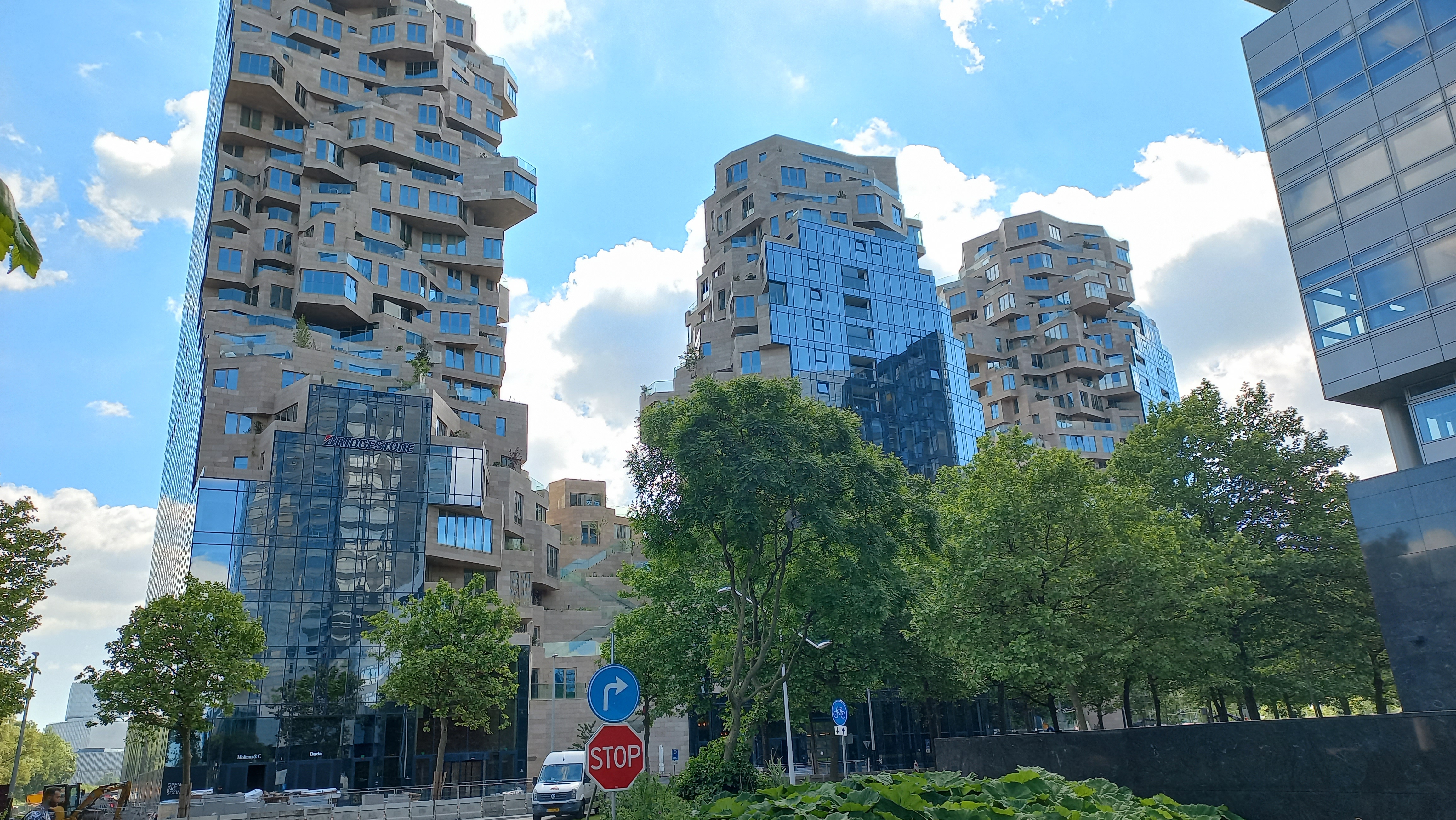
The Valley — Amsterdam-Zuid, home of Miele X since May 2023
Miele X — Current Location
The Valley, Amsterdam-Zuid · Since May 2023

The Valley, Amsterdam — Photo: Wikimedia Commons

July 2020
Launch Date
Miele X launched on 10 July 2020, with an initial team of 14 employees
May 2023
Moved to The Valley
New community space at The Valley, Amsterdam-Zuid, opened 17 May 2023
~100
Target Team Size
Started with 14 employees; objective to scale to ~100 team members
Sources: Launch date, team size, location — Invest in Holland press release · Valley Community Space opening — IAmExpat.nl, May 2023 · Miele X — Miele X on LinkedIn

The mandate of Miele X covers the full digital commerce and marketing stack: ecommerce platform development (including the headless commerce architecture), digital marketing and customer acquisition, data and analytics, AI-driven product discovery, and the rollout of customer engagement platforms. Its platform and strategy outputs affect Miele's digital channels across all markets — built and managed from within the Amsterdam tech ecosystem.

Miele X in context: The decision to locate Miele's global digital hub in Amsterdam — not in Gütersloh, not in a German tech city — reflects a deliberate talent strategy. Amsterdam's English-speaking, internationally mobile digital workforce provides a different talent pool than the Westphalian industrial heartland where Miele's engineering capability is rooted. The two sites serve different strategic functions within the same company.

B2B digital ecommerce — 17 Miele Professional online shops for institutional buyers

Miele's digital commerce spans both consumer and institutional markets. In addition to the ~47 B2C webshops enabled and coordinated through Miele X, Miele Professional operates 17 dedicated B2B online shops — serving hospitals, research laboratories, dental practices, and commercial catering organisations — on the Intershop Commerce Platform, deployed in Microsoft Azure Cloud infrastructure and in operation since 2012. Each subsidiary manages its own professional shop presence, with Intershop's multichannel architecture enabling independent localisation across markets without separate platform deployments.

For the professional segment, Miele is also implementing SAP Commerce Cloud and SAP Sales Cloud to digitise B2B sales workflows, integrating online ordering with institutional procurement and service management processes. The Miele group additionally operates an operational procurement portal for supplier interactions, separate from the customer-facing B2B webshops.

Sources: 17 Miele Professional B2B shops, Intershop platform — Intershop Communications — Miele case study · SAP Commerce Cloud implementation — SAP — Miele Professional B2B sales case study (2023) · Procurement portal — Miele.com — Operational Procurement Portal
Global Digital Hub Ecommerce Growth AI Product Discovery Headless Commerce CRM — Bloomreach Omnichannel Strategy B2B Digital Commerce 17 Professional Shops Amsterdam-Zuid The Valley
07
Leadership
Fourth-generation family co-leadership — Miele and Zinkann families both represented at executive level

Miele's executive board is structured to reflect the dual family ownership: one executive director from each family serves as co-proprietor and joint head of the company. Dr. Markus Miele represents the Miele family; Dr. Reinhard Zinkann (great-grandson of the co-founder of the same name) represents the Zinkann family. Four further board members cover the operational functions. In 2025, Stefan Koss joined as the Finance & Administration director, completing the current six-person executive team.

Executive Director & Co-Proprietor
Dr. Markus Miele
Represents the Miele family as co-proprietor and Executive Director. One of approximately 80 family stakeholders who are direct descendants of co-founder Carl Miele. Jointly leads the company alongside Dr. Reinhard Zinkann.
Executive Director & Co-Proprietor
Dr. Reinhard Zinkann
Represents the Zinkann family as co-proprietor and Executive Director. Great-grandson of co-founder Reinhard Zinkann — a fourth-generation family owner. The dual co-proprietor structure has governed Miele since 1899, maintaining the original partnership between the two founding families.
Executive Director — Technology
Dr. Stefan Breit
Leads the Technology function across Miele's product development, production engineering, and R&D operations across 19 global production plants.
Executive Director — Marketing & Sales
Dr. Axel Kniehl
Leads Marketing and Sales globally, including oversight of the digital transformation agenda coordinated through Miele X in Amsterdam and the 49 company-owned sales subsidiaries.
Executive Director — HR & Corporate Affairs
Rebecca Steinhage
Leads Human Resources and Corporate Affairs for approximately 23,000 employees across Miele's global operations, including the Amsterdam digital hub and all production and sales entities.
Executive Director — Finance & Administration
Stefan Koss
Joined the Miele executive board in 2025. Leads Finance and Administration for the Miele group, overseeing financial operations across a €5.16B revenue business operating in ~100 countries.
Sources: Executive board — Miele.com — Management · Stefan Koss appointment — Miele.de press release
08
Sustainability
EcoVadis Gold, Science Based Targets, and carbon neutral on Scopes 1 & 2

Miele has embedded sustainability into both its product positioning and its operational commitments. On the product side, premium durability is the core argument: appliances built to last reduce replacement frequency and the total material and energy cost over a product's lifetime. On the operational side, Miele has made formal public commitments under the Science Based Targets initiative (SBTi) and has achieved carbon neutrality across all of its locations for Scope 1 and Scope 2 emissions.

Certification / CommitmentDetailSource
EcoVadis Gold Medal 84/100 points · Top 2% globally · 96/100 in environment category Miele.com — Sustainability
Science Based Targets (SBTi) Committed to SBTi; targeting 50% reduction in absolute Scope 1 & 2 emissions by 2030 (baseline 2019); net-zero by 2050 Miele.com — Sustainability
Carbon neutral — Scopes 1 & 2 Carbon neutral across all Miele locations for Scope 1 (direct) and Scope 2 (indirect energy) emissions Miele.com — Sustainability
German Sustainability Award Received for the domestic appliances category — second time since 2014 Miele.de — press release
ACT Label — My Green Lab Multiple Miele Professional glassware washers earned ACT Label Certification for sustainability in science Lab Manager · MieleUSA — Professional Sustainability
Source: Miele.com — Sustainability · MieleUSA — Sustainable Future
EcoVadis significance for Miele Professional: An EcoVadis Gold Medal ranking — top 2% globally with 96/100 in environment — is a direct procurement advantage in institutional markets. Hospitals, research institutions, and public-sector organisations are increasingly required to demonstrate supply chain sustainability. Miele Professional's EcoVadis standing becomes a competitive differentiator in procurement decisions where sustainability credentials are scored.
EcoVadis Gold Science Based Targets Carbon Neutral Scopes 1&2 Net-Zero by 2050 German Sustainability Award ACT Label — My Green Lab Immer Besser
About the Author

TrendsOnFire is a AI based market intelligence platform publishing editorial analysis on retail, technology, supply chain, people and transformation trends across Europe.

Created by Olga Bressers, a senior executive with experience in commercial & digital operations, ecommerce, omni-channel strategy, operations, programs and business transformation.

Contact →
Type to search published reports and trend intelligence